
Curtain Room Divider Ideas for Studio Apartments (No Drilling Required)
Specific curtain room divider setups for studio apartments: right rod height, fabric fullness math, tension rod limits, and IKEA VIDGA ceiling track install for renters.


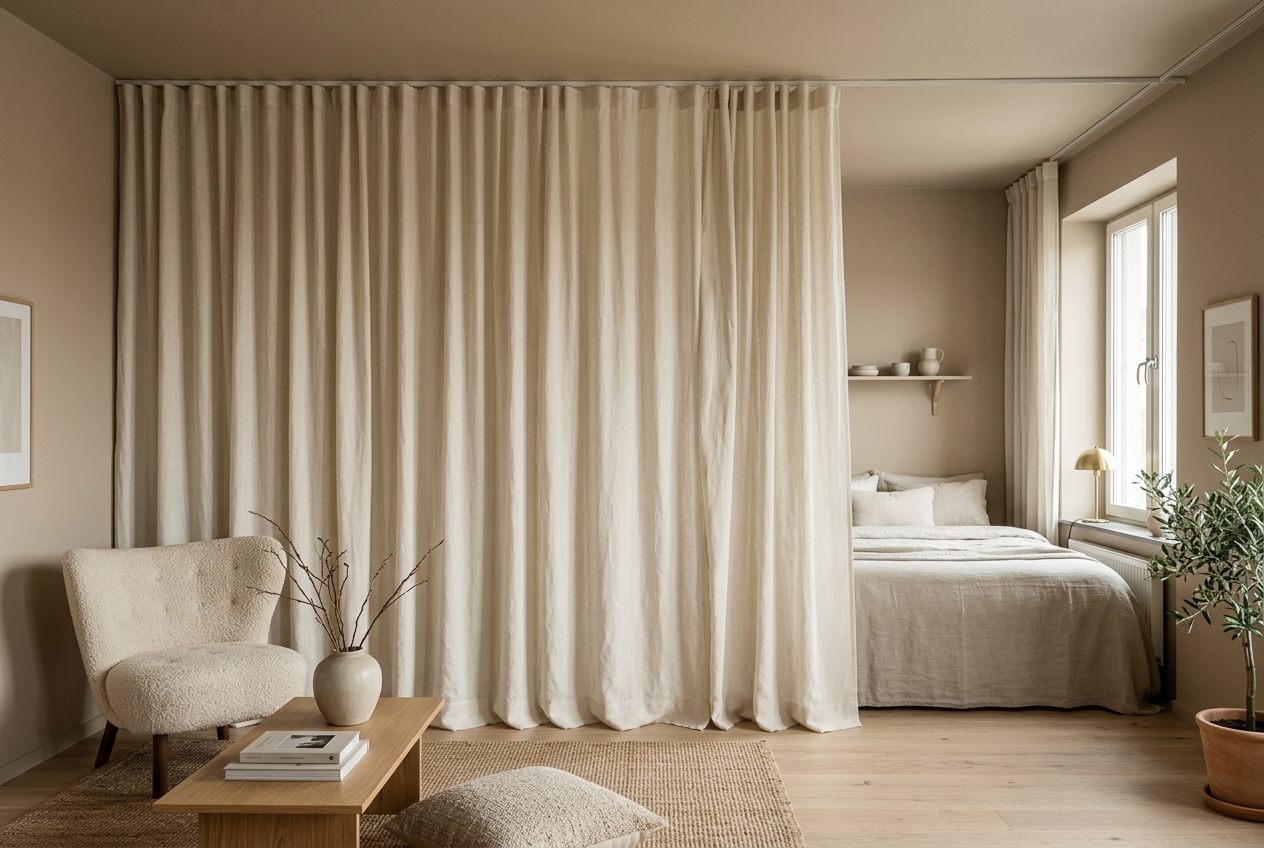
A curtain hung ceiling to floor does something furniture cannot: it gives you a door-shaped boundary in a space with no doors. In a studio, that boundary is the difference between a room that reads as one large sleep-work-eat closet and one that reads as an actual apartment.
Setup, products, and the mistakes that make most of these look cheap.
Jump to:
- Measure your span and ceiling first
- The IKEA VIDGA ceiling track system
- Tension rods: when they work and when they don't
- How much fabric you actually need
- Where to place the curtain in your studio
- Which fabrics work and which ones sag
- Five things that make curtain dividers look wrong
- FAQs
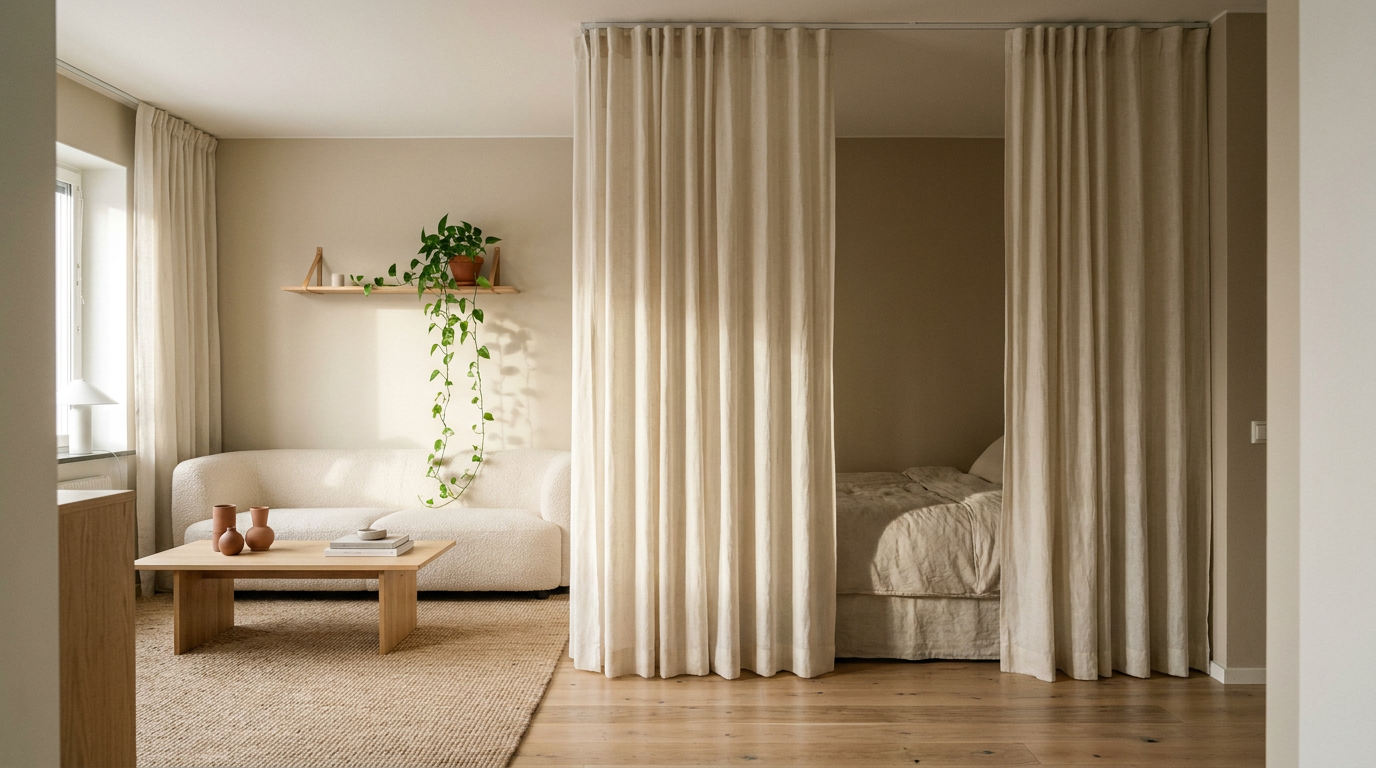
Measure your span and ceiling first
Before buying anything, write down two numbers: the width of the span and your ceiling height.
Span determines your hardware. Most tension rods top out at 8-9 feet. Most standard curtain panels run 50-54 inches wide. For a 10-foot span at 2x fullness, you need roughly 240 inches of curtain width, which is five 50-inch panels.
Ceiling height sets your panel length. Standard panels come in 84, 95, and 108 inches. Eight-foot ceilings (96 inches) want 95-inch panels hung from a ceiling track; they land about an inch above the floor. For 9-foot ceilings, 108 inches.
The number most people skip: the gap between the rod and the ceiling. A room divider reads as intentional when the rod sits within 1-2 inches of the ceiling, not 6 inches below it. That gap is the difference between a designed partition and a shower curtain strung across a room.
The IKEA VIDGA ceiling track system
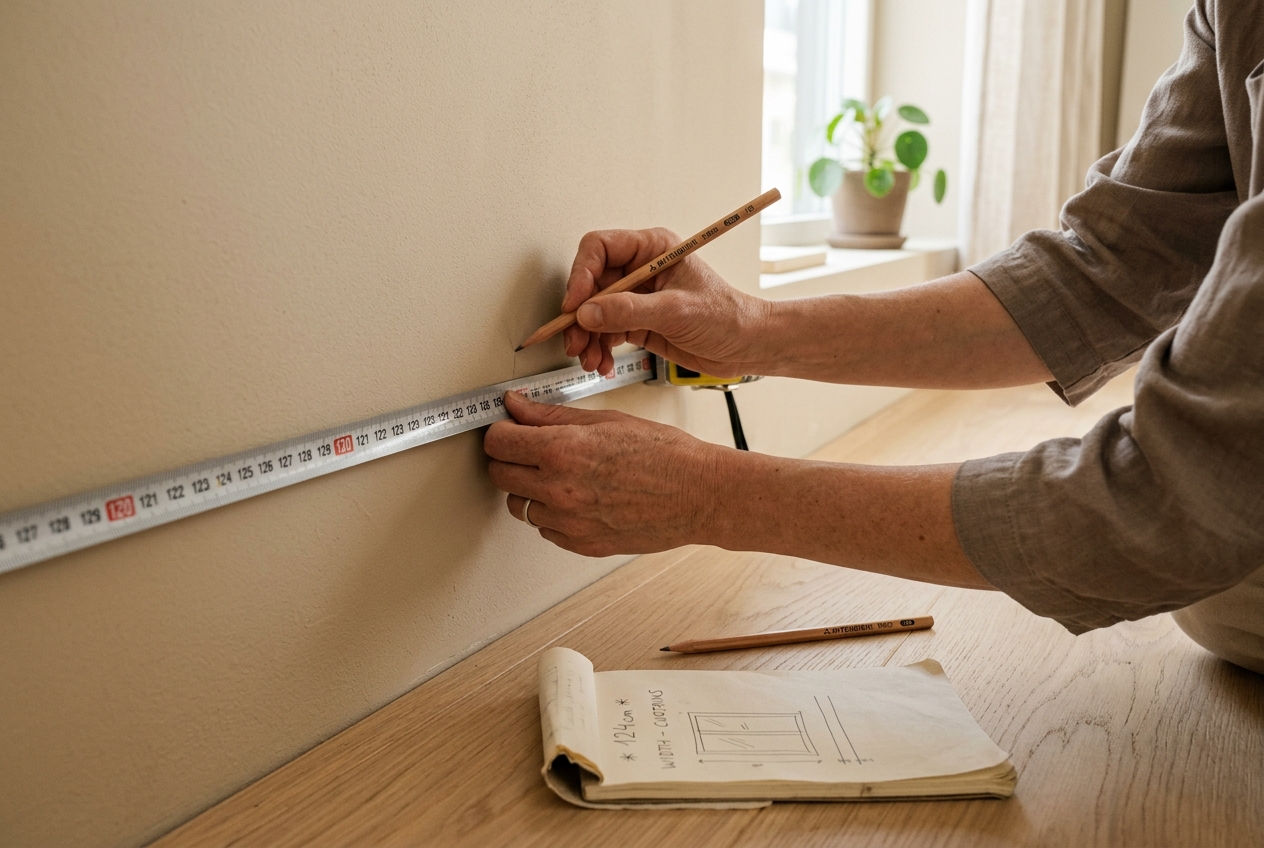
For renters who can put a few small holes in the ceiling, the IKEA VIDGA ceiling track is the cleanest setup. It mounts flush to the ceiling, runs straight or around corners, and takes standard curtain panels on gliders. No hardware hanging below the rod line.
Individual rails are about 55 inches long, joined end-to-end for wider spans. Two or three connected sections cover a 10-foot divide.
Installation is three or four small ceiling anchors. Patch them at move-out, touch up the paint, done. If the ceiling is concrete, use a hammer drill; drywall takes standard plastic plugs.
The VIDGA corner kit adds a 90-degree turn so the curtain wraps around two sides of a bed. That turns a dividing line into an actual sleep nook.
For a broader look at all the room divider options available to renters (curtains, bookshelves, sliding panels) the studio apartment room divider ideas guide covers each type and when each one makes sense.

Tension rods: when they work and when they don't
Tension rods have one real use case: spans under 6 feet, fabric that weighs almost nothing.
In a doorway or narrow alcove, a 28-72 inch tension rod handles lightweight linen or sheers fine. Across a 10-12 foot studio span, the rod bows in the middle within weeks. I have seen this enough times that I would call it a guarantee.
For renters who truly cannot drill, the alternative is a floor-to-ceiling compression system: vertical posts that press against the floor and ceiling, with a horizontal rod connecting them. Amazon sells adjustable models spanning 28-144 inches wide and 48-120 inches tall. No drilling, repositionable.
One real trade-off: a ceiling track disappears above the panels. A compression frame has a visible vertical post at each end of the curtain, standing in the room. Fine in most studios, just not invisible.
Lightweight fabric only, with any tension setup. Anything heavier than medium-weight linen or cotton pulls the system down.
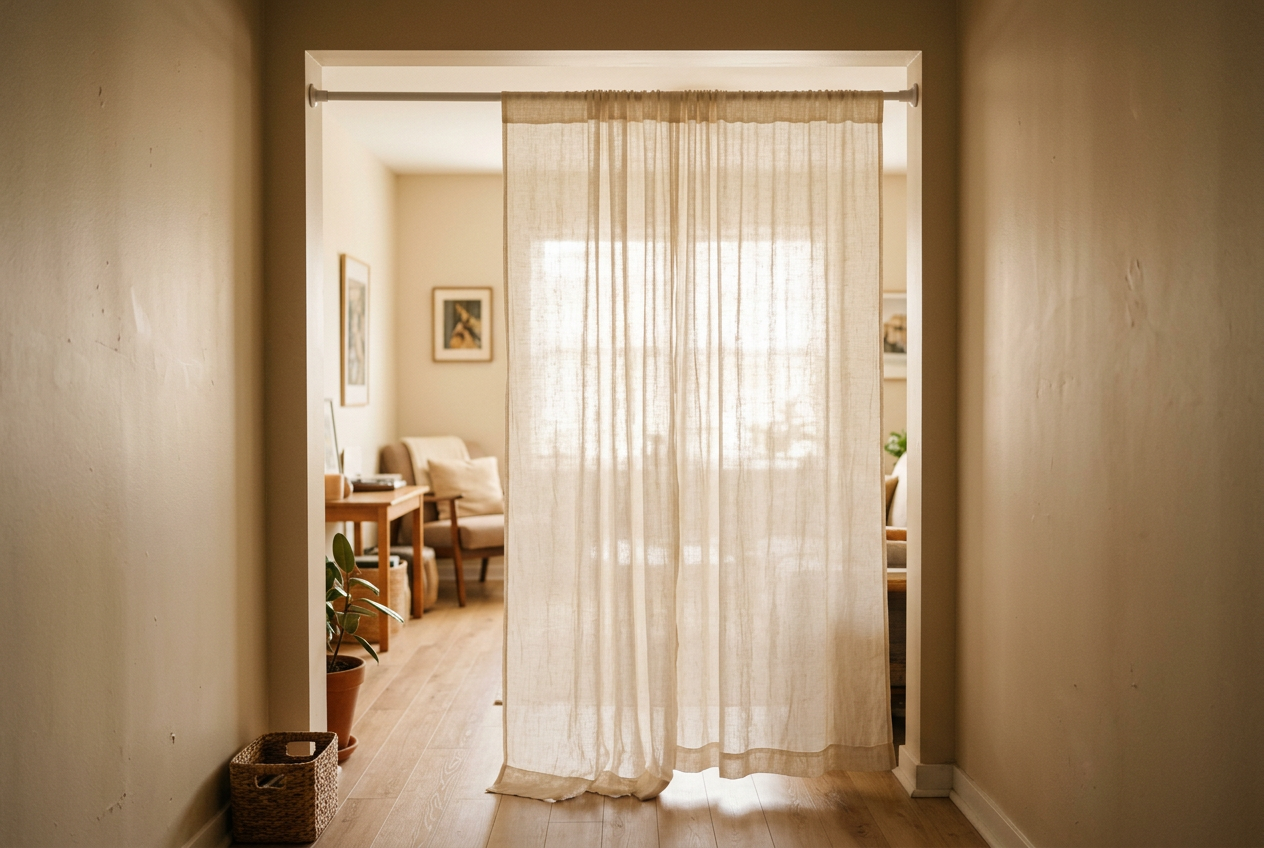
How much fabric you actually need
Most curtain dividers look wrong for one reason: not enough panels. The fabric stretches flat across the span with no fold, no weight, no drape. It ends up looking exactly like a shower curtain, which is not the goal.
The fix is buying for fullness. A room divider needs 1.5x to 2x the width of the span.
For a 10-foot span (120 inches) at 2x fullness: 240 inches of curtain width. Five 50-inch panels gets you to 250. Good.
For a 12-foot span (144 inches): 2x fullness is 288 inches. Six 50-inch panels gives you 300. Also good.
If you are shopping 54-inch panels at IKEA or Target: four panels is 216 inches, which is 1.8x for a 10-foot span. Workable, not ideal.
Room/Dividers/Now on Amazon sells panels designed specifically for room dividers: heights up to 9 feet, widths up to 10 feet per panel, around $70-150. More expensive than standard IKEA panels, but the fabric is built for an open span, not a window.

Where to place the curtain in your studio
Every studio has a natural dividing line. The job is finding it.
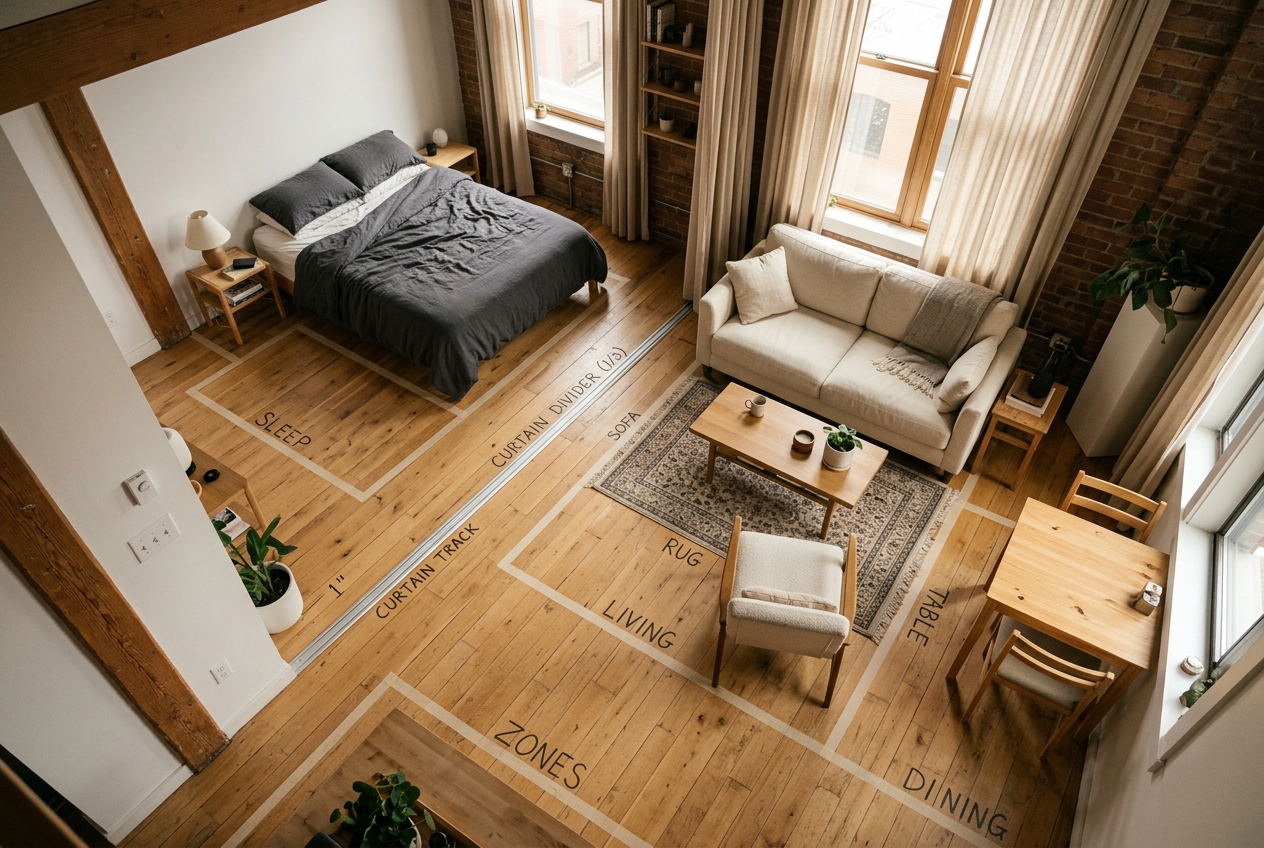
In a rectangular studio, that line usually falls about one-third from the bedroom end. Bed in the back third, living area and kitchen in the front two-thirds. Hang the curtain there, close it at night, and the bedroom disappears.
In a railroad layout, rooms connected end to end, the curtain runs perpendicular to the long wall. Find where the sleeping end stops and the living end starts, and cut across there.
Two things override everything else: the curtain cannot block your main natural light, and it cannot cross a path you use ten times a day. If the only window sits behind where the divider would go, the living area goes dark. Use a sheer instead of an opaque panel, or move the line.
If you are still mapping zones before the curtain goes up, the bedroom-and-living-room-in-one guide covers studio layouts in more detail.
Which fabrics work and which ones sag
A room divider asks more of its fabric than a window does. No frame at the edges, no sill at the bottom. Most fabrics that behave fine in a window fall apart across an open span.
Linen and linen-blend are the most reliable. They hang clean from a ceiling track, stay light enough for tension systems, and fall in straight vertical folds. Undyed cream or warm beige also fits with almost any neutral palette, which matters in a studio where one loud color is visible from every angle.
Sheers work when light flow matters more than privacy. The room stays bright on both sides. Silhouettes show through. Not a problem until it is.
Blackout fabric is the right call for a sleep zone that needs real darkness. The weight almost always means a ceiling track with proper anchors rather than any tension setup. One note of caution: a full-width blackout curtain drawn during the day makes a small studio feel like a cave. If you want the blackout effect, put it only on the bed-facing layer and keep a sheer on the living-area side.
Velvet and heavily lined canvas sag. They are window fabrics. An open 10-12 foot span will expose that within weeks.

Five things that make curtain dividers look wrong
The rod is too far from the ceiling
A rod hung 6 inches below the ceiling reads as a curtain, not a partition. Mount within 1-2 inches of the ceiling. This one detail matters more than the fabric, the color, or what you paid.
The panels are too short
Curtains stopping 3-4 inches above the floor look like a measuring error. Graze the floor cleanly, or puddle slightly. Floating above the floor does not look intentional on any budget.
Not enough panels
Curtains stretched flat with no folds look like a tarp. If you can see through the overlap, buy one more panel. Minimum 1.5x fullness.
Wrong fabric for the hardware
Heavy blackout panels on a basic tension rod pull it down within weeks. Heavier fabric needs a ceiling track with proper anchors. Match the fabric weight to the hardware.
A color that belongs to a different apartment
The curtain is large. If its color has no relationship to anything else in the room (not a pillow, not the rug, not a ceramic on the shelf) the studio reads as assembled from three different places. Cream, warm white, natural linen, soft sage: safe in almost any neutral palette. Pick a color that already appears somewhere in the room.
FAQs
Can I use a curtain as a room divider in a studio apartment? For renters, curtains are one of the better divider options. Minimal hardware, easy to move when the layout changes, and they come down completely at move-out. Get the rod close to the ceiling (within 1-2 inches) and buy enough fabric (1.5x-2x fullness) so the panels fold rather than stretch flat.
What is the best curtain track system for a studio apartment divider? The IKEA VIDGA ceiling track. It mounts flush, can turn corners, works with standard panels, and the damage is a handful of small ceiling anchors you patch before moving out.
How many curtain panels do I need for a room divider? For a 10-foot span at 2x fullness: five standard 50-inch panels (250 inches total). For a 12-foot span: six panels. If you are buying 54-inch panels, four covers a 10-foot span at about 1.8x, close enough.
Can I hang a curtain room divider without drilling? For spans under 6 feet, a tension rod works. For anything wider, look at a floor-to-ceiling compression rod system that uses pressure against the floor and ceiling instead of wall anchors. Both options require lightweight fabric. Heavy fabric defeats tension systems.
What type of curtain fabric works best for a room divider? Linen or linen-blend. It hangs clean, holds structure across an open span, and works with tension rods. Sheers if light matters more than privacy. Blackout if the zone needs real darkness, but blackout fabric needs a ceiling track with proper anchors and not a tension rod.